By the early 2000s, the Web no longer felt like an experiment. It had become business infrastructure. Websites were expected to work around the clock, online services were becoming essential, and organisations increasingly depended on systems that had once been regarded as little more than interesting technology.
Around this time we introduced Rhythmyx, one of the first commercial content management systems I worked with. It brought new capabilities but also a new way of thinking. Development became more structured, marketing expectations grew, and the pressure to deliver increased. The Web was no longer simply about building useful tools; it had become a business in its own right.
One Christmas we carried out a major deployment just before the holiday. As anyone who has worked in IT will recognise, software has an unfortunate habit of revealing its most interesting bugs only after everyone has gone home. My colleague Peter spent much of his Christmas break trying to resolve unexpected problems. It was one of those moments that reminded us how much responsibility the Web now carried. What had once been static pages viewed by enthusiasts had become systems on which organisations depended.
Around this time I noticed a change. In the early days, “web development” meant doing a little of everything: HTML, graphics, servers, databases, networking and whatever else was needed. As organisations grew, those responsibilities became divided into specialist roles. Interface designers, web designers, multimedia developers, database administrators and network engineers all became experts in their own fields. The advantage was deeper expertise. The downside was that fewer people understood how the whole system fitted together. Increasingly, my role became one of connecting those pieces and helping trace problems that crossed the boundaries between teams.
A good example was the familiar “500 Internal Server Error”. A web designer might assume it was a server problem. A server administrator might suspect the database. A database specialist might look for faults in the application. In reality, the cause could lie almost anywhere: a configuration change, a permissions problem, a missing library, a database connection or an application bug. Solving it often depended less on deep knowledge of one component than on understanding how all the components interacted. In our case, after two weeks, our best developers were stumped. So I stepped in and suggested they check the server was correctly reporting the error. In fact, it was a brand new server and had been misconfigured – the problem was solved.
During these years I also found myself thinking more about the future than the present. I had become interested in ideas such as electronic currencies, including an early proposal known as eCU (see footnote), which suggested that money itself might one day exist primarily as information moving across networks. At the time it felt speculative. Looking back, it now seems less remarkable than it did then.
Not long afterwards I was asked to write a paper for senior management exploring how I thought the Web might develop over the following decade. Alongside international collaboration and changing patterns of scientific publishing, I briefly considered the possibility that advances in artificial intelligence might arrive sooner than many people expected. I had no particular insight into how it would happen, only the feeling that computing was beginning to move beyond simply storing and retrieving information towards generating new ideas. Whether I was right or wrong mattered less than the exercise itself. One of the privileges of working in technology is that you are constantly encouraged to think a little way beyond the horizon.
Around 2009, I briefly met Tim Berners-Lee, creator of the World Wide Web (not the Internet, as some mistakenly believe) and Jacob Nielsen, named “guru of Web page usability” in 1998 by The New York Times, Tim was engaged in a group conversation in an Institute foyer when I joined the conversation without noticing at first who he was. I met Jacob at a conference on the future of usability on the Web.
Looking back now, what strikes me most is not the technology itself but the pace at which it changed. During my career I watched the Web evolve from hand-written HTML pages uploaded over dial-up connections into the foundation on which businesses, publishers and scientific organisations increasingly relied. The excitement of those early years gradually gave way to reliability, security, accessibility and scale. The Web had grown up.
People often remember the early Web through the companies that became household names. I remember it through FTP sessions, scanned photographs, frozen screen locks, millions of web pages, inaccessible HTML, late-night deployments, and the quiet satisfaction of making things work.
Five in the Morning
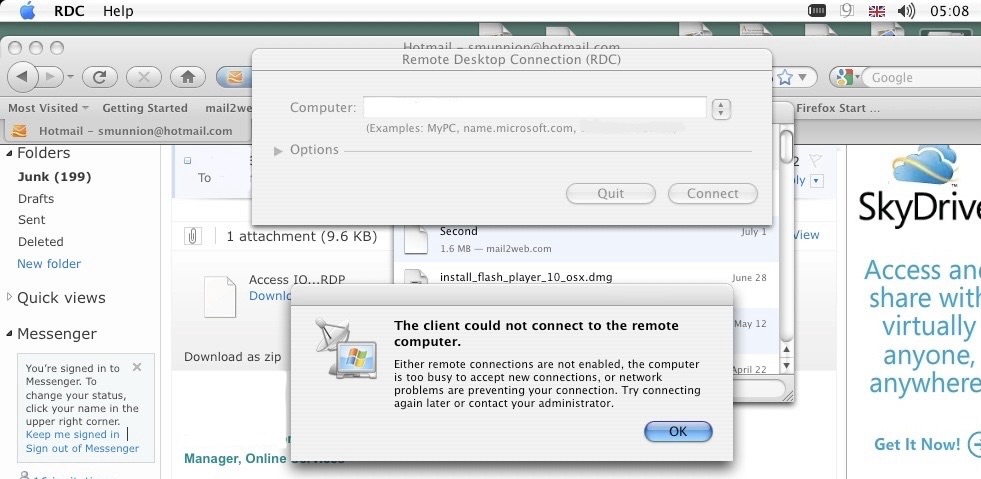
The photograph below was taken at around five o’clock one morning during software testing at the Institute of Physics, towards the end of my career. Looking at it now, I’m struck by something I hadn’t noticed at the time. After more than twenty-five years working on the Web, I was still curious enough to turn up before dawn just to make sure everything worked properly. Technologies had changed beyond recognition since my first HTML page, but the fascination hadn’t. I think that’s what the photograph really captures.
You can always find a full index of all the articles on the page under About me in the main menu.
Web Stories
The Tunnel of Forgotten Macs
During the water leak before the comms room move, the Institute’s Facilities Manager led me down two floors below ground level one day and along a passage to some store rooms. But we passed a door that I hadn’t noticed before, so I asked where it led. She said I could take a look, so I did. Lined up along an empty passageway were around eighteen redundant Bondi Blue iMac G3s. Once they had been among the most distinctive computers in the world; now they sat forgotten beneath the building, like an unexpected museum exhibit from the early Web.
eCU Footnote
From Google
ECU (often stylized as eCU) was an early centralized digital currency and electronic gold-backed project that operated during the early 2000s tech boom. It modeled itself after the original European Currency Unit but was designed for internet commerce. Why It Failed So Quickly. The Gimmick: The project sold physical, transparent acrylic promotional tokens embedded with a holographic security strip or micro-serial number to simulate “tangible digital money.” The Collapse: Unlike modern decentralized cryptocurrencies, it relied completely on a centralized issuer. Amid the regulatory crackdown following the Patriot Act of 2001—which targeted early digital gold currencies like e-gold for lacking KYC/money-laundering compliance—the project panicked, ran out of capital, and went defunct within a matter of months.

