If you missed it you can read Part 1, on the stretch from Tring to Wendover, including Boddington Fort.
Tolkien’s Country
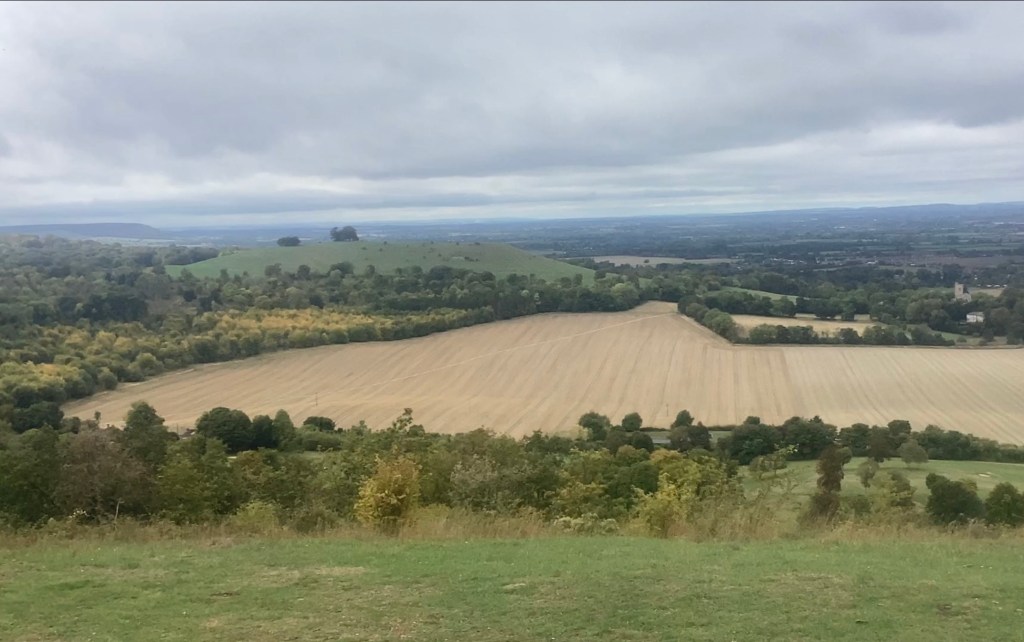
Tolkien lived and taught in Oxford for many years, so many ancient sites in Oxfordshire and surrounding counties, including Hertfordshire and Buckinghamshire, would have been well within reach for a day out. Boddington Fort strongly resembles the Old Forest topographically in The Fellowship of the Ring, so you can read about this in more detail using the link above.
Beleriand
Beleriand sank beneath the sea in The Silmarillion, somewhat analogous to the sinking of Doggerland, an event that shaped ancient Britain and kickstarted the popular route of The Ridgeway 7000 years ago. To find out more, read on.
The Sinking of Doggerland and rise of The Ridgeway
To understand Britain before The Great Ridgeway (which includes the Icknield way north of Ivinghoe Beacon), we must understand two things.
First, Britain wasn’t yet an island but was connected to Europe by a landbridge we now call Doggerland. The name lingers on in Dogger Bank, an enormous sandbank below the waves that presents a danger to fishermen.
The second is that there is a popular idea that Britain’s population 10,000 years ago consisted of tribes constantly at war. A more accurate model is of tribes interacting in trade and worship, with annual pilgrimages every year to the most popular ceremonial sites on the South Coast in Dorset and Wiltshire, where sites like Avebury and Stonehenge still survive today. Popular trade goods would have been Welsh gold, Cornish tin and luxury goods from Europe arriving via ports in Norfolk on the East Coast, not far north of London today. In fact, in those days, the River Thames connected with the Rhine system, where they both drained south as what we now call the English Channel.
But approximately 8150 years ago, a great landslide in Norway caused a tidal wave that waterlogged Doggerland, making it probably very difficult to negotiate. Futhermore, the rising sea levels after the last Ice Age that had already been progressively inundating Doggerland finally sank it beneath the waves over the next 1000 years. Now Britain was an island.
The Great Ridgeway, a track that wound its way along a chalk ridge southeast from Norfolk to the great ceremonial sites in Dorset, was probably already in use and possibly continued further north. But with the sinking of Doggerland, trade arrived in Norfolk ports, so about 7000 years ago, the Great Ridgeway probably became the ideal route south.
Why Walk Along a Ridge?
The truth is more complex than one answer. Walking along a chalk ridge usually means well-drained ground and less trees to negotiate, England being heavily forested at the time. It also gives greater views of the route forward, making it harder for robbers to ambush travellers. But you’re probably thinking walking in hills is unwise. Actually, counterintuitive though it may be, the highest ridge, with less up and down inclines, can be the easiest route, when the whole landcape is crisscrossed by valleys.
A Last Thought
You could argue that The Ridgeway offered a model to Tolkien for the Great South Road (The Greenway). That’s something to think about when you walk it.

 Before I start, I want to clarify that this is a review of the films only. I have read the books between 13-20 times (I lost count at 13) and seen the whole trilogy of films more than 20 times. I have also read The Hobbit 3 or 4 times, read the Silmarillion twice, The Book of Lost Tales, Unfinished Tales and The Children of Hurin, so I would say I am pretty familiar with Tolkien’s work. The films are a pretty good reflection of the books, but they are not an accurate rendering on screen, so if you really want to know and understand Tolkien, read the books; the man was a genius, so I can’t even attempt to do him justice in a review of his work. We are simply talking about Peter Jackson’s excellent movies here. I will attempt to outline what is good and bad about the movies and compare them with the books, as well as Harry Potter and Game of Thrones, both of which it’s frequently compared to. This whole review is a spoiler, so if you don’t want to know what happens to the characters, don’t read this.
