
The Ridgeway, England’s oldest road at 7000 years, runs along the Chiltern Hills, as it heads South to Avebury in Dorset.
My stepmother passed away in the last week and my father passed away almost exactly a year ago. I wasn’t close to either in the final decades, but it made me think about the Autumn of life. I suppose post Covid, many of us have lost family, so it seems appropriate to post something personal, because I last did this during lockdown.
(Right-click the image to see the high-resolution version)
Last week, knowing she hadn’t long, I decided to walk part of the Ridgeway, the oldest road in Britain at 7000 years. I walked the first part, going south from Pitstone Hill to Tring Station (~10.5 miles), in the sweltering heat of the 2022 Summer. I thought this section, from Tring Station to Wendover Station (~10.5 miles) would be a doddle. I was wrong!
I believe Boddington Fort is a serious candidate for Tolkien’s inspiration for the hilltop clearing in the Old Forest from The Fellowship of the Ring. Here’s why.
The weather was perfect: cloudy and not too hot. The route was well signposted, and I made great progress, until I left Buckinghamshire and entered Hertfordshire. Suddenly, I reached a road, and no signs! I turned left and searched for half a mile – nothing! I went back and tried the other way. I even asked some guys with a mobile signal, but they knew nothing about the Ridgeway, and we couldn’t find our exact location on google maps anyway. I continued west, because I already planned to visit Boddington Iron Age Fort, and remembered it was east of the Ridgeway. Luckily, a campsite owner showed me a shortcut to Wendover Woods Park, wherein lies the Fort.
I had lunch on the North-west side of the Fort, where I took the photograph above. Then I headed south to an exit from the Park shown on maps, hoping to regain the Ridgeway.
Now, I have a pretty good sense of direction, but the maze of paths that twist and turn around Boddington hill disorientated me. I could see farms and houses in a valley, far below, but the ground between was thick with fences, trees and overgrown fruit bushes. I couldn’t find an exit, so I walked a half mile back to the Park’s Information Centre to ask. On a map, a young ranger pointed to the exit and told me which path to follow, saying:
”You can’t miss it!”
I was doubtful, but I followed his directions. By now, I reckon I had walked almost 2 miles more than necessary in the Park. Every few hundred yards, there were bridleways and cycle paths branching off. I had no idea which to follow, because no sign mentioned an exit, and all paths looked the same. I was seriously doubting I would find an exit, when I came to the bottom of the hill and a place where two paths crossed. My sense of direction kicked in, and I gambled. I was right, and I finally reached a barrier and emerged behind a farm.
From here, I turned left, toward where I guessed the Ridgeway was, and had to climb a 1 in 4 hill. By sheer luck, I turned round at the top, out of breath, to look down the hill and saw a concealed gate marked ‘Ridgeway’ on my left.
This is a very long-winded story perhaps, but it illustrates how disorientating the maze of paths is around Boddington Fort. Some go round and round and others crisscross each other. And I am not a fan of Herfordsnire’s signposting!
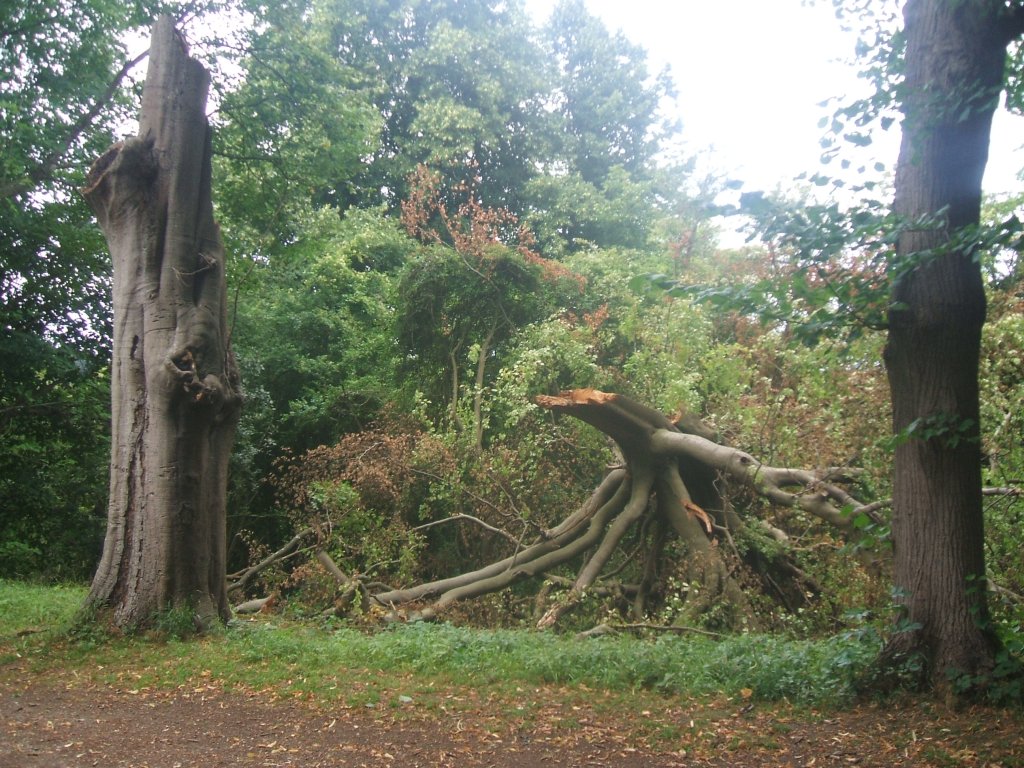
I believe Boddington Fort is a serious candidate for Tolkien’s inspiration for the hilltop clearing in the Old Forest from The Fellowship of the Ring. For a start, it’s only 21 miles from Oxford, where he lived. Secondly, I have seen a photo of his family on an excursion into the country by car (I couldn’t find it, but if you know where to link to it, let me know). I know Tolkien loved historical sites, so I think he would have visited the Fort on one if these excursions.
Furthermore, the twisting, circling paths are a dead-match for Boddington, as is the only possible view from the top of the hill, because of the trees, on the West-side. Tolkien mentions views North, South and West but not East (which is also not possible at Boddington for the thick trees on the shallow East side).
Finally, the view into the valley south matches; it seems lost in time and is very secluded, containing only a few farms, houses, stables and a grange. I feel sure Tolkien had this place in mind when writing this passage. Go there yourself if you can, and you’ll see what I mean.
A few comparisons with the closest Iron Age forts in Oxfordshire:
21 miles – Oxford to Boddington
21 miles – Oxford to Blewburton Hill (not wooded)
21 miles – Faringdon Castle (not on a steep hill)
16 miles – Cherbury Camp (not wooded)
Hardwell Castle is closer but not on top of a hill
Tolkien’s text
‘The hobbits led their ponies up winding round and round …”
‘On the south-eastern side the ground fell very steeply …’
Let me know if you think I’m right in the comments.
The Hittites (updated)
Tolkien loved history, particularly ancient Greek history, so I am sure the Hittite culture interested him. A day before my stepmother’s stroke that led to her death after only two months, I had the urge to recover a whole lost album’s worth of photos of Turkey from 1995. (I spilled a cup of tea on it, in case you’re wondering – yes, beside my lounge chair was a stupid place to stack photo albums!) I still had the negatives, but I knew it would be time-consuming and expensive. It was! In the end, I filled two albums, but it rekindled my inspiration for a work-in-progress on the Hittites. Here is a sample:
Copyright © 2024 by Lazlo Ferran
All Rights Reserved
In a cramped, blackened tomb, crouching over a stone cot within an alcove, somebody cries “No, don’t do this!”
A second man growls, flexing his heavily-splinted forearm, as he tries to prise open the cot with the tip of a sword. He stops, breathing hard, and hisses:
“Where is it?”
The first man had only time for a glimpse through an opening in the drystone wall to a short line of olive trees upon a grassy slope that he knew led down to the Sea. The scene looks serene, a shocking splash of colour against the charcoaled world within, its aeons of dark silence broken only by flies and heavy breathing.
“Don’t disturb the dead, Dar! The door’s at the back, under a slab. Can you see anything behind?
“Nothing! We need lamps, Alix! I’ll feel.”
“Not the sword! Hands! We’ll need it sharp.”
Stumbling over stonework in the dark, Dar drops to his knees and feels around a large slab behind the alcove.
“I think I’ve found it! I feel cool air on my fingers.”
Prising the heavy slab up together, the two men drop into a shallow tunnel and are on their way toward the Palace.
 Occult, Sci-fi & Military